Reading & Writing to Analyze

Analysis is a critical thinking skill you use quite often, in academic as well as professional and everyday reading and writing. You may analyze the argument in a text or article, the benefits of a business proposal, and/or the ideas offered in a news editorial or television news commentary. Analysis helps determine the quality of the information you read by extracting and examining different aspects of that information.
Reading to Analyze
Analytical reading starts with finding and understanding a main idea, and then considers the validity of that main idea by studying its parts, to see how logically those parts fit together. As the American Heritage Dictionary states, analysis is “the separation of an intellectual…whole into constituents for individual study.” Analysis essentially takes apart the whole text and examines how the parts relate to one another to make up the text’s ideas and content, in order to determine the quality of the ideas and content.
There are four main parts to a text that you may analyze, and multiple sections within each part.
- Content
- Language
- Structure
- Purpose
Breaking a Text into its Parts for Analysis [1]
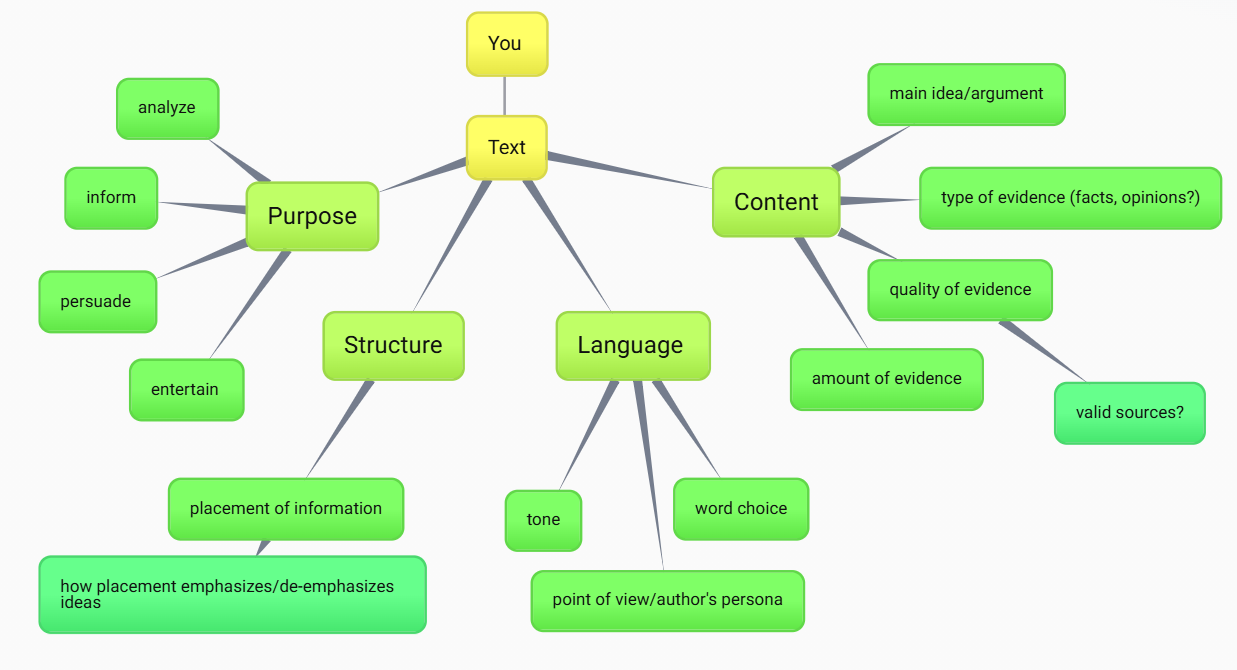
Analytical Reading Process
Reading a text for the purpose of analysis usually requires you to read that text more than once. Upon a first reading, take note of characteristics to investigate further. Do you agree or disagree with certain ideas? Did you react to certain phrases? How do the ideas in the text relate to your own experience? Application of reading skills such as previewing, annotating, note-taking, and summarizing all help you note characteristics that you may want to investigate further as they promote your ability to understand the text. Understanding is the basis for analysis.
Fuller analysis happens after a first reading, when you delve into the text more completely, asking and answering specific questions about its parts.
Ask and answer three basic questions as a starting point for analyzing a text:
- What is the main idea?
- What is the author’s purpose?
- What additional pieces of the text should I question more fully (content, language, structure), based on the author’s purpose?
Main Idea

Always start by identifying the main idea of the text that you have read. What is the one thing that the author wants you to understand after reading the text? The main idea may be stated directly in the text, or it may be implied, in which case you need consider the text carefully in order to identify its main idea.
Purpose
Once you identify the main idea, identify the purpose in order to determine how/whether to analyze the text.
- If the purpose is to persuade or logically argue, you always need to analyze the text to see if the main idea is justified, and to see how the supporting ideas, language, and structure relate to the main idea. Persuasion and argument need to present logically valid information to make the reader agree intellectually (not emotionally) with the main idea.
- If the purpose is to inform or explain, you usually need to analyze the text, since the text needs to present valid information in objective language to meet its purpose of informing (as opposed to persuading) the reader. You may analyze the text in terms of its structure as well, since information placement can influence its importance and how that information is perceived.
- If the purpose is to entertain, then you may or may not need to analyze the text for its content. Writing that entertains does not necessarily have to be either logical or complete in order to accomplish its purpose. You may want to analyze the text for language, though, to see how an author uses language to accomplish her purpose.
Additional Questions for Analysis
When you decide to analyze a text, and when you determine the pieces (content, language, structure) on which to focus the analysis, ask and answer additional analytical questions.
Questions to analyze content:
- Is the information mostly fact, opinion, or a combination of both? Is the type of information appropriate to the purpose and main idea?
- Is the support relevant to the main idea – does it relate to and enhance the main idea?
- Is the support logical?
- Does supporting evidence come from trusted, valid sources?
- Is there enough support to verify the main idea and supporting ideas?
- Does the support consider and deal with an opposing viewpoint if there is a significant opposing viewpoint?
For example:
If the text’s main idea is that new work-at-home policies need to become standardized within specific professions, the support needs to include many different reasons why, and each reason why should have its own supporting evidence. Just offering one reason with its accompanying evidence, that standardization would increase employee retention, is not sufficient support in itself.
and:
In the argument about work-at-home policies, does the support acknowledge what’s good about previous and current practices? Note that strong support acknowledges and then logically explains away any opposition simply by offering stronger logical evidence on one side than the other.
Questions to analyze language:

- What do the words imply/connote and how do the words influence the reader’s understanding of the main idea?
- Are the author’s tone and general point of view intended to sway the reader to a certain way of thinking about the main idea?
Questions to analyze structure:
- Why is certain information placed as it is within the text? How does that placement emphasize or de-emphasize the information?
- How does the order of information align with the text’s main idea and purpose?
These questions are a starting place for text analysis. Note that more questions may occur to you based on the specifics of the text.
Try it
Read the article, “Why Aren’t Governments as Transparent as They Could Be?” Then ask and answer the following analytical questions based on this article.
Basic Analytical Questions
- What is the main idea?
- What is the author’s purpose?
- What additional pieces of the text should I question more fully (content, language, structure) based on the author’s purpose?
[reveal-answer q=”1″] See how one reader answered these basic analytical questions [/reveal-answer]
[hidden-answer a=”1″]
- What is the main idea?….the main idea is that governments should be as transparent with data as those governments, businesses, and digital services are with our own personal data, and that we should be demanding such transparency from government
- What is the author’s purpose?…to persuade/argue
- What additional pieces of the text should I question more fully (content, language, structure), based on the author’s purpose?…all three, content, language, and structure, since the purpose is to persuade
[/hidden-answer]
Questions to Analyze Content
- Is the information mostly fact, opinion, or a combination of both? Is the type of information appropriate to the purpose and main idea?
- Is the support relevant to the main idea–does it relate to and enhance the main idea?
- Is the support logical?
- Does supporting evidence come from trusted, valid sources?
- Is there enough support to verify the main idea and supporting ideas?
- Does the support consider and deal with an opposing viewpoint if there is a significant opposing viewpoint?
[reveal-answer q=”2″] See how one reader answered questions to analyze content [/reveal-answer]
[hidden-answer a=”2″]
- Is the information mostly fact, opinion, or a combination of both? Is the type of information appropriate to the purpose and main idea?…Information is a combination of fact and opinion. Facts exist in the verifiable information (growth in government spending, number of information requests that government denied). Opinions exist in many statements (“we willingly open more of our lives to the public,” “it’s not just new technologies that are eroding open government principles”). There seems to be more opinion than fact, but the fact about denied information requests is powerful.
- Is the support relevant to the main idea–does it relate to and enhance the main idea?…yes. The support relates to and enhances the idea that we should demand more transparency of information from government.
- Is the support logical?…for the most part, I think so, although some of the language is intended to persuade emotionally. The evidence seems to be the right type, but there could be more factual evidence.
- Does supporting evidence come from trusted, valid sources?…Some of the sources are acknowledged as valid sources: Pew Research Studies, Associated Press. Other sources lead to links that are newspaper articles, and I need to review each article to determine validity. Some sources might be questionable. For example, Carnegie Mellon is a respected research institution, but the author quotes from a professor at Carnegie Mellon. However, if you follow the links, this information is based on an academic paper that was published in a respected professional journal, which gives the information greater credibility (as journals usually are peer-reviewed). It would have made a stronger argument, though, to have included more factual information. Other references come from sources that have a definite bias, e.g., Public Engines.
- Is there enough support to verify the main idea and supporting ideas?…yes, although more factual information about both local and federal government denial of information would have established this issue more solidly. Or, on the other hand, confining the argument to just local or federal government might have focused the argument more solidly.
- Does the support consider and deal with an opposing viewpoint if there is a significant opposing viewpoint?…There is one, but it’s not dealt with very fully–the info about using public information to shame others.
[/hidden-answer]
Questions to Analyze Language
- What do the words imply/connote and how do the words influence the reader’s understanding of the main idea?
- Are the author’s tone and general point of view intended to sway the reader to a certain way of thinking about the main idea?
[reveal-answer q=”3″] See how one reader answered questions to analyze language [/reveal-answer]
[hidden-answer a=”3″]
- What do the words imply/connote and how do the words influence the reader’s understanding of the main idea?…There is some language that’s intended to persuade emotionally as opposed to logically: “flying off the shelves,” and the whole paragraph “As our governments’ powers of surveillance and their ability to be transparent are both increasing dramatically, we’re giving them the former without demanding the latter. I can’t think of anything more un-American and infantilizing than this kind of deference to government.”
- Are the author’s tone and general point of view intended to sway the reader to a certain way of thinking about the main idea?…yes. The point of view is definitely toward openness of information. The tone attempts to be objective, but emotional language pops in.
[/hidden-answer]
Questions to Analyze Structure
- Why is certain information placed as it is within the text? How does that placement emphasize or de-emphasize the information?
- How does the order of information align with the text’s main idea and purpose?
[reveal-answer q=”4″] See how one reader answered questions to analyze structure [/reveal-answer]
[hidden-answer a=”4″]
- Why is certain information placed as it is within the text? How does that placement emphasize or de-emphasize the information?…The author starts and ends on personal notes, which relate more directly to every reader. He puts his evidence in the middle, which readers can understand, but which may not be as personally relatable. So, his placement of information seems intentional as his purpose is to persuade readers.
- How does the order of information align with the text’s main idea and purpose?…yes, as he wants readers to act by going to certain sites intended to support transparency of information.
[/hidden-answer]
Media Attributions
- geralt-man-4334177 © Gerd Altmann is licensed under a CC0 (Creative Commons Zero) license
- Screenshot 2026-05-13 114824 © free mind map created with bubbl.us is licensed under a CC0 (Creative Commons Zero) license
- geralt-concept-2791440 © Gerd Altmann is licensed under a CC0 (Creative Commons Zero) license
- sophieja23-woman-687560 © Sophieja23 is licensed under a CC0 (Creative Commons Zero) license
- mohamed_hassan-book-3801210 © Mohamed Hassan is licensed under a CC0 (Creative Commons Zero) license
- geralt-problem-67054 © Gerd Altmann is licensed under a CC0 (Creative Commons Zero) license