Developing Support

When you’re ready to develop support and draft an essay based on your insights from reading a text, it’s helpful to have a working thesis for that essay as a place to start. If you only have a topic—and not an assertion you want to make about that topic—then you may need to circle back to your annotations, questions, notes, and/or mind maps to review the information you jotted down.
What were your thoughts as and after you read the text? Are there similar ideas that occur multiple times? Find an idea, or a pattern of ideas, which interest you and about which you have some ideas yourself. Create an angle that makes an assertion about the topic to offer your ideas and insights. Your topic and angle together create your working thesis; an essay’s support develops the angle of your working thesis.
Note the phrase “working thesis.” As you start developing support for your thesis, you may find that the support yields information that the thesis does not plan for. So you may need to edit your thesis or else decide not to pursue that line of support. You review and finalize your thesis once you fully develop your support.
The following video, while focused on writing a single paragraph, offers solid information that explains the concept of support and how support relates to a main idea.
video Creating Great Supporting Sentences. Authored by: Jonathan Newsome. Located at: https://www.youtube.com/watch?v=nWKMLadQbrc. License: Other. License Terms: YouTube video
General Process for Developing Support

- Create a working thesis.
- Analyze your working thesis to see what type of insights and information you’ve promised your reader in the angle.
- Create working topic sentences to address the promise in the thesis’ angle. Extract ideas one by one from the thesis’ angle, and write a topic sentence for each idea, with its own topic and angle. Remember that topic sentences offer general ideas that your support will then specify.
- Fill in with examples and details under each topic sentence, to fully explain each topic sentence’s angle. Start with the topic sentence about which you have the most to say, even though you may not end up placing that topic sentence first in the finished essay. Just start in the place that’s easiest for you, to get started writing.
- Understand that writing is an iterative process. As you start to develop your support, you may decide to circle back to your thesis and topic sentences as well as move forward with developing details, examples, and insights. For example, while developing support, you may decide that you need to add another topic sentence that did not occur to you initially.
You can individualize this general process in any way or combination of ways that work for you. For example:
- Just start writing based on your working thesis to see what topic sentences and supporting examples evolve.
- Use lists or mind maps to develop topic sentences and supporting details.
- Categorize your support and name the categories using an outline or idea matrix.
As you do more writing, you’ll create and refine your own process for developing support. Just make sure that you’re developing topic sentences and support that relate to your working thesis.
Example – One Student’s Process of Developing Support
Working Thesis
Because images in advertising art reflect their social context, you can infer what’s important to the general public at different eras through analyzing ads.
Using the Working Thesis to Develop Ideas for Support
Using the working thesis example, the student determined how many and which eras to include. They knew they couldn’t write about all eras, because the assignment was only a 3-5 page essay. And they know that they wanted to write about advertising in the U.S. as opposed to other cultures, because as a U.S. resident, that’s the one they knew the most about. They decided to write about particular decades as a way of narrowing the scope, to enable them to delve more deeply into the support. They ended up choosing the 1950s, 1990s, and 2020s.
They started out with a mind map.
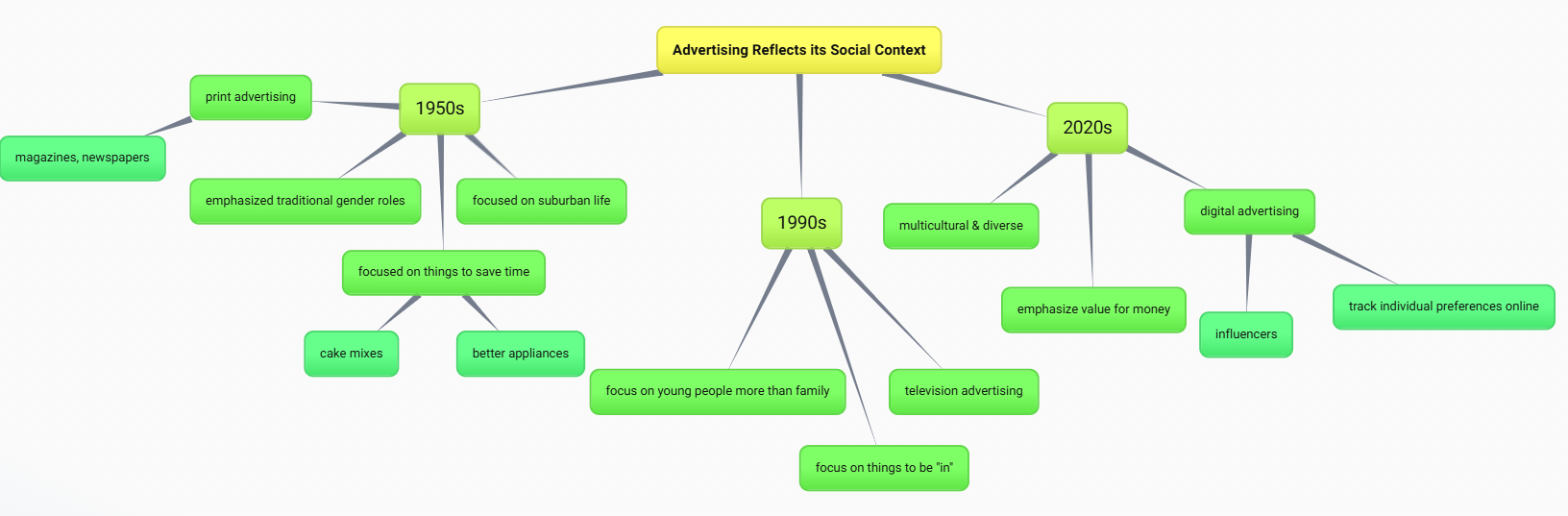
created with the free version of bubbl.us
Then they developed a topic sentence for each decade:

- Ads in the 1950s tended to progress from black and white to bright colors as the decade progressed and highlight conventional values and gender roles; they glossy look enhanced the feeling of security and a growth economy after having come through World War II.
- Ads in the 1990s usually were colorful, but started to push previously accepted limits of “appropriateness” with newly provocative images, as well as focus more fully on celebrities. Both of these developments may have occurred because of the relatively stable economic and social climate of the time, which provided a stable base for experimentation.
- Ads in the 2020s are very diverse and individualized since so many are in digital format; however they increasingly focus on value for cost, since they are being offered in a less stable economic climate than the 1950s or 1990s.
After developing the working topic sentences, the student had an additional insight—that ads during each decade could be used to predict upcoming trends in advertising, to a certain extent. They decided to circle back to revise the working thesis, and then add another topic sentence to deal with this insight as a way of putting their thoughts into broader context toward the end of the essay. They ended up with the following working thesis.
Revised Working Thesis
Images in advertising art reflect their social context. From analyzing the color palette, style, and content of ads in the 1950s, 1990s, and 2020s, you can both infer what was important to society during these decades as well as see how the decades may lay the groundwork for future experimentation in the field of advertising.
The Goal when you’re Developing Support
The important goal is to have a working thesis, categories of support, and names for your categories. This will help you see whether you have:
-
- enough support (if there are categories with very little information)
- slanted support (categories overloaded with information)
- inappropriate support (categories that are too general), or
- support only marginally related to your thesis (category names that don’t quite relate to the angle in the thesis)
Types of Support
There are many types of support that specify ideas in topic sentences. You’ll use some or all types of support, depending on the purpose of your essay. Commonly-used types of support consist of the following:
- Reasons
- Facts
- Statistics
- Quotations
- Examples
- Personal Observations
- Interviews

The type of support you include in an essay will depend on your writing purpose and audience.
For example, if you’re attempting to analyze an issue in order to persuade your audience to take a particular position on that issue, you might rely on facts, statistics, and concrete examples, rather than personal opinions, to provide logical evidence.
If you’re writing an essay to offer a personal reaction to something you observed, you might rely on observations, examples, and details.
If you are writing a research essay which synthesizes information from many texts, you’ll include more summaries, paraphrases, and quotations from sources, along with reasons and facts.
If you’re writing any of these essays for an audience that is not familiar with your topic, you’ll include more concrete details and examples to make sure they understand your points.
Realize that all types of support are usable in all types of essays, and that it’s typical to blend many or all of these types of support when supporting a topic sentence. Also understand that although it’s useful to recognize different types of support, writers don’t necessarily think in terms of “I need a fact here” or “I need an observation there.” Writers just write. Conscious consideration of different types of support occurs as you continue to work with and review your support, in terms of your thesis, topic sentences, purpose, and audience.
The two videos that follow explain different types of support.
video Essay Writing – Body Paragraphs – Supporting Details. Provided by: GoReadWriteNow. Located at: https://www.youtube.com/watch?v=1Y0hM5Ck4T0&feature=youtu.be&t=148. License: Other. License Terms: YouTube video
video Essay Writing – Body Paragraphs – Insightful Analysis. Provided by: GoReadWriteNow. Located at: https://youtu.be/_Mr6n9ZgQMI?t=177. License: Other. License Terms: YouTube video
try it
Two key, inter-related skills in developing support are 1) the ability to distinguish between more general and more specific information, as units of support usually move from general –> specific, and 2) the ability to figure out a logical sequence of information.
Practice these skills by ranking the sentences below from most general (topic sentence) to most specific, a ranking which should also move logically from more basic to more specialized information.
- One 12-gram serving of Crisco contains 3g of saturated fat, 0g of trans fat, 6g of polyunsaturated fat, and 2.5g of monounsaturated fat.
- There are different types of unsaturated fats: monounsaturated, polyunsaturated, and omega-3 fatty acids.
- According to its label, Crisco contains a higher percentage of unsaturated than saturated fat.
- Mono and polyunsaturated fats can lower your risk of Type II diabetes.
- Unsaturated fats provide a number of benefits to the body.
- All three types of unsaturated fats can help lower your risk of heart disease.
[reveal-answer q=”1″] Check your answer [/reveal-answer]
[hidden-answer a=”1″]
- Unsaturated fats provide a number of benefits to the body.
- There are different types of unsaturated fats: monounsaturated, polyunsaturated, and omega-3 fatty acids.
- All three types of unsaturated fats can help lower your risk of heart disease.
- Mono and polyunsaturated fats can lower your risk of Type II diabetes.
- According to its label, Crisco contains a higher percentage of unsaturated than saturated fat.
- One 12-gram serving of Crisco contains 3g of saturated fat, 0g of trans fat, 6g of polyunsaturated fat, and 2.5g of monounsaturated fat.
[/hidden-answer]
Units of Support
When you’re developing support, think in terms of “units of support” as opposed to paragraphs. A unit of support develops the ideas in topic sentence, and that unit of support may include more than one paragraph.
As you develop units of support, keep in mind that those units usually move from more general (the unit’s topic sentence) to more specific (details and examples that explain and support the angle in the topic sentence) and optionally back to more general (re-statement of the topic sentence, as a lead-in to the next topic sentence and unit of support, if it makes sense within the flow of the essay). Also remember to paragraph when needed within each unit of support.
Paragraphing within the Draft/Units of Support

Like sentence length, paragraph length varies. There is no single ideal length for “the perfect paragraph.” Know, though, that if you have lengthy units of support and don’t paragraph within them, your readers might wonder if the paragraph is ever going to end, and they might lose interest.
The most important thing to keep in mind is that the amount of space needed to develop one idea will likely be different than the amount of space needed to develop another.
In general, start a new paragraph when:
- You’re ready to begin developing a new idea.
- You want to emphasize a point by setting it apart.
- You’re getting ready to continue discussing the same idea but in a different way (e.g., shifting from comparison to contrast).
- You notice that your current paragraph is getting too long (more than three-fourths of a page or so), and you think your writers will need a visual break.
On the other hand, you don’t want your essay to include too many short paragraphs in a series. In general, combine paragraphs when:
- You notice that some of your paragraphs appear to be short and choppy.
- You have multiple paragraphs on the same topic.
- You have undeveloped material that needs to be united under a clear topic.
Enough Support
How much support is “enough?” That’s a question that only you as a writer can answer. Know that the number of paragraphs in an essay as well as the number of topic sentences and units of support depend on what’s needed to fully support the angle in the thesis sentence. There’s really no way to know that until you start writing.

However, one good method to gauge “enough” is to put yourself into a reader’s role. Draft your essay, set the draft aside, and then re-read the draft.
Ask if a reader can easily relate your concepts to real life, based on the support you have provided.
If you’re analyzing an issue, ask if you’ve provided different viewpoints and shown how yours is the most valid, through your evidence and explanations.
You may circle back to develop fuller support, or to hone your existing support, once you write and then consider your essay draft. So, just start developing your support using a process that makes sense to you, and see how your draft develops. There will be plenty of time to add, delete, and re-organize paragraphs and units of support in the revision process.
Media Attributions
- pramod-tiwari-FmcFN77NmXY-unsplash © Pramod Tiwari is licensed under a CC0 (Creative Commons Zero) license
- kaja-kadlecova-e04R6GDZdvY-unsplash © Kaja Kadlecova is licensed under a CC0 (Creative Commons Zero) license
- Screenshot 2026-05-13 171003 is licensed under a CC0 (Creative Commons Zero) license
- annie-spratt-Wvxoh9dj3Oo-unsplash © Annie Spratt is licensed under a CC0 (Creative Commons Zero) license
- brooke-cagle-_6cz9KUvnxM-unsplash © Brooke Cagle is licensed under a CC0 (Creative Commons Zero) license
- christina-wocintechchat-com-m-vLwH8bWoi_8-unsplash © Christina @ wocintechchat.com M is licensed under a CC0 (Creative Commons Zero) license
- geralt-question-mark-3717894 © Gerd Altmann is licensed under a CC0 (Creative Commons Zero) license