Outline and Idea Matrix
Creating an outline or an idea matrix is a useful step in planning to write. Both provide a brief “frame” or overview of ideas that you intend to write about. Both show the relationships among those ideas, as similar ideas are on similar levels. Each one also allows you to see if all of the supporting ideas relate to the overall main idea, and each one allows you to see if you have any gaps that need to be filled.
Essentially, outlines and idea matrices show the conceptual or idea structure of the writing you’re planning.
Outline

An outline places similar ideas on similar levels. For example, all main ideas that support your working thesis start at the left-hand margin. Different levels of supporting details are indented depending on their level of specificity.
In addition to distinguishing between major supporting ideas and more minor examples and details, outlines are useful because, at a glance, they allow you to see if all major supporting ideas relate to the overall main idea.
Outlines show the conceptual or idea structure of a text.
Here’s an explanation of outlines, using outline form.
Main Idea/Working Thesis: Writers use Outlines to Generate and Organize Ideas
I. An outline identifies proposed content and key ideas for a piece of writing.
A. You may identify the point you want to make (your thesis) at the top or start of an outline, as the main idea.
B. Your main supporting points become the main sections of the outline.
1. You can also add details and examples to your supporting points.
a. Details and examples are indented; the level of indentation shows the level of detail.
II. An outline helps you evaluate and make informed decisions about ordering ideas in a piece of writing.
A. You can see if one idea logically leads into the next, or if certain information needs precede other information in order to support a reader’s understanding.
B. You can see if a particular order (e.g., cause and effect, comparison and contrast) might make sense.
III. An outline shows at a glance the amount of information you have for each idea group.
A. You can easily identify where you need to add/subtract information.
B. Amount of information also informs decisions about ordering information.
1. You may want to move from most important (most developed) —> least important (least developed), or vice versa.
Two More Outline Examples
Outline created by ChatGPT
ChatGPT Prompt:
Provide an image of an outline on issues with relying on AI for a college essay, 4/28/26
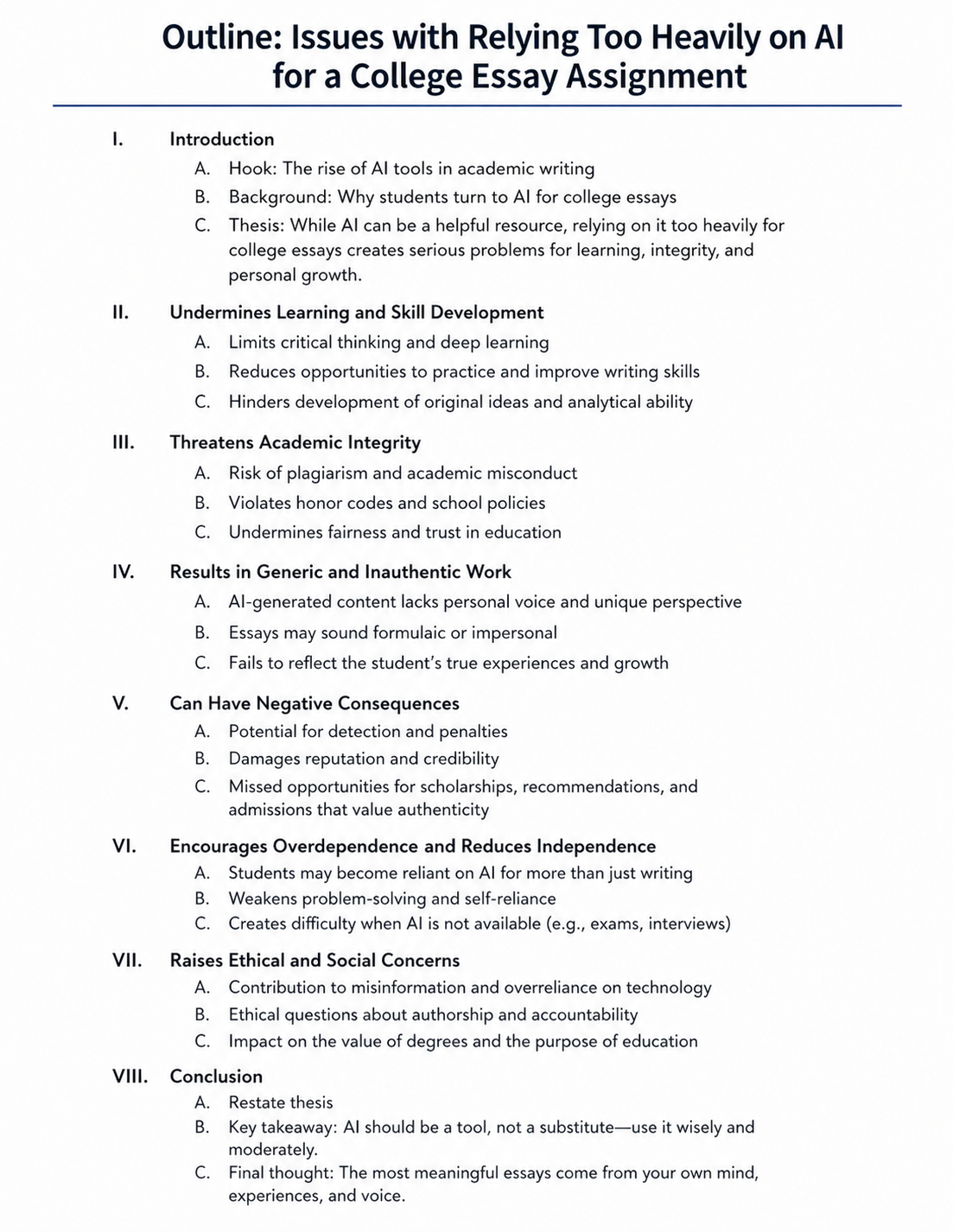
Outline version of the information in the idea matrix (below):
Working Thesis: Eating too much heavily-processed food can lead to a number of harmful effects on a person’s health.
I. Heavily-processed foods often contain empty calories…
A. Body may not be getting nutrients…
B. Poor nutrition leads to more frequent illnesses…
C. May lead to disease that develops from nutritional deficiencies
II. Many heavily-processed foods are high in fat…
A. May heighten bad type of cholesterol…
B. May lead to weight gain…
C. Weight gain may lead to development of different cancers…
III. Higher salt and sugar may harm a person’s heart and blood systems…
A. May harm blood pressure…
B. Higher risk of cardiovascular disease…
C. May lead to elevated blood sugar, pre-diabetes…
Review of Outlining Conventions
- Each outline should start with a main idea as opposed to a topic, for example: Sloppy and neat people differ in their attitudes and actions. (Not just the topic “sloppy and neat people”)
- Idea groups should be parallel (same type of information in all of the A,B,C groups; same type of information in all of the 1,2,3 groups)
- Idea groups should be logically linked, with A leading logically into B, etc.
- Supporting details and examples in each idea group are differentiated visually by being more indented.
video How to Create a Clearly Structured Essay Outline. Provided by: Scribbr. Located at: https://www.youtube.com/watch?v=hwzfnDbZCRQ. License: Other. License Terms: YouTube video
Try It
Read the following paragraph [1] and outline it, identifying the overall main idea of the paragraph, the main supporting ideas, and details that more fully explain the supporting ideas. Then check your understanding by comparing it with the sample outline.
[reveal-answer q=”2″] Sample Outline [/reveal-answer]
[hidden-answer a=”2″]
Main Idea: Although men think of themselves as the aggressors, says this writer, it is really the women who make the decisions when a courtship is beginning.
I. Women pick a potential mate out of the crowd
A. Women position themselves near the man they have selected and, with a glance or a smile, invite him to make contact
II. In conversation, a women initiates each increasingly intimate stage
A. Continuing eye contact, moving closer, and touching all signal permission to make further advanced
III. Women’s signals are so subtle, men are only subconsciously aware of them
[/hidden-answer]
Here is one template that you are welcome to download and adapt to help you write:
- University of Mary Washington’s The Basic Outline of a Paper
Idea Matrix

Like an outline, an idea matrix is a way to prewrite once you have an idea of what you want to write about. An idea matrix for writing is just what it sounds like – it’s a table or grid that helps you identify, organize, and develop your ideas. You lay out your ideas in columns and rows, and fill details in the appropriate squares.
How to Create an Idea Matrix
Working Thesis: Write your topic and your assertion about that topic. Your thesis is a “working” thesis because you may find that you need to circle back and revise it as you develop your supporting ideas and details. The thesis and support need to relate directly to one another.
Supporting Ideas: In this column, insert main ideas that support your assertion in the working thesis. What would convince a reader to support your assertion? These ideas will eventually become your topic sentence assertions.
Details: In each row, insert details and ideas that further develop and exemplify each supporting idea group. Note that you do not have to fill up every square of the grid.

For example, here’s an initial idea matrix a writer developed to identify possible topic sentence ideas:

The writer’s next step was to add notes in each supporting idea row for examples and details to develop that supporting idea:

After adding notes, the writer assessed their idea matrix:
- They decided that they really didn’t have much to say about fiber, so they deleted that supporting idea.
- They realized that “history of heavily-processed foods” did not directly provide an idea that supported their assertion about harming health, so they deleted that concept.
- They realized that they needed to say more about fat intake, so they added more details in that row.
- They tweaked and added details overall.
- Then they turned the supporting ideas into topic sentence assertions to create the following revised idea matrix.

The writer may have two more iterations of this essay planning matrix:
- If they decide on a certain order for the information, they may decide to re-order the rows and tweak the working thesis to indicate a particular pattern of organization.
- If they decide to support some of the assertions with research, they might add rows under each topic sentence row to house appropriate quotations or summaries.
The final idea matrix, if the writer made these two changes, might look like this:


As you might have deduced, after working progressively with an idea matrix to plan your essay, it’s a relatively easy next step to draft that essay. An idea matrix helps you identify the “bare bones” – the skeletal structure of ideas in an essay that you then can develop with examples and details. It also helps you stay on track, since you can see at a glance if there’s an idea that doesn’t directly support the assertion in the working thesis, or that doesn’t fit with the other ideas.
Here are two templates that you are welcome to download and adapt to help you write:
Idea Matrices in Other Contexts
Idea matrices are used in many other contexts. The following video focuses on generating ideas in a business to engage consumers. Although the context is different, you’ll see the process of using a matrix to generate ideas is the same.
Note that this video does not have subtitles; if you want to view the text of the narration, please link here to Design Thinking Using an Idea Matrix
video Design Thinking: Using an Idea Matrix. Provided by: Skillsoft YouTube. Located at: https://www.youtube.com/watch?v=HwGRc3VrBmY. License: Other. License Terms: YouTube video
[1] outline exercise adapted from Basic Reading and Writing, Lumen Learning. CC BY: Attribution. https://courses.lumenlearning.com/suny-basicreadingwriting/chapter/outcome-summary-skills/ This open educational resource attributes the paragraph, which is part of a SlideShare, as follows:
Major and Minor Details. Authored by: Nicole Keith. Provided by: Guilford Technical Community College. Located at: http://www.slideshare.net/NicholeKeith/major-and-minor-details. License: All Rights Reserved. License Terms: SlideShare Terms of Use[/embed]
Media Attributions
- © Kaleidico is licensed under a CC0 (Creative Commons Zero) license
- ChatGPT Image Apr 28, 2026, 12_21_54 PM
- davidzydd-square-2724387 © DavidZydd is licensed under a CC0 (Creative Commons Zero) license