Structuring Support: Patterns of Organization
There are different, relatively standard patterns for organizing ideas that mirror the ways in wihch humans think about their world and organize their thoughts in order to communicate:
- Pro/Con
- Problem/Solution
- Process
- Comparison and Contrast
- Division and Classification
- Cause and Effect
Academic writing often mirrors and sometimes asks you to analyze and offer ideas using some of these patterns. For example, you may be asked to contrast Erik Erikson’s Psychosocial Theory of Development with Jean Piaget’s Cognitive Development Theory in terms of learning and explain why you think one theory better explains how people learn.
You may be asked to apply an inventory management process to address the problem of multiple and consistent out-of-stock items for an online retailer.
Or you may be asked to analyze how different groups, such as business owners, workers, consumers, or foreign governments, are affected by tariffs on foreign goods.

Developing ideas about such issues goes hand-in-hand with understanding specific patterns in writing – they are iterative processes that help one another. And understanding different writing patterns can help you figure out an organic order of information in which to present ideas in your writing.
Patterns of organization are like pieces of a puzzle that you get to fit in order to mirror the ways in which humans think about their worlds and organize their thoughts in order to communicate.
Pro/Con

You often think in terms of pros and cons when you analyze the merits or characteristics of a thing, person, or idea (e.g., buying a new refrigerator, whom to vote for, whether you’re in favor of or against an increase in school taxes). An essay that uses a pro/con structure has to have a thesis that indicates that you’ll be analyzing the benefits and detriments of a process, a concept, an action – whatever you decide to analyze.
You can create a pro/con structure in different ways, depending on your purpose.
An essay using a pro/con structure does not necessarily just have two topic sentences, one for pro and one for con, although you can structure in this way.
You also can structure by creating multiple pro/con topic sentences and units of support to fit your needs.
- You may want to present pros and cons equally, with multiple topic sentences and units of support for each side.
- You may opt to focus more fully on either pros or cons, and so would have many topic sentences for the side you emphasize.
- You may want to address particular points and alternate between pros and cons.
Organize your topic sentences and units of support in a way that makes sense given your thesis and purpose.
Problem/Solution

Articulating a problem and offering a solution/s is also a common human thought process (e.g., how to keep the deer from eating out of your garden, how to juggle working from home and homeschooling your children during a pandemic).
An essay using a problem/solution pattern starts with a thesis sentence that indicates that a problem will be identified and solutions will be analyzed.
The first topic sentence and unit of support usually present the problem.

Then there may be many topic sentences and units of support that analyze and evaluate different possible solutions.
Or there may be many topic sentences and units of support that present many aspects of one overall solution.
Process

An essay using a process pattern is often straightforward, as it usually presents a series of steps in chronological order.
However, a college essay that uses a process pattern needs to offer more than a list of steps, since it does not show college-level analytical thinking if you simply describe a series of steps.
College writing about a process needs to have a thesis that makes a point about that process (e.g., Baking bread, while relatively simple, still involves a number of complexities, variables, and just plain things that can go wrong.).
Each topic sentence then makes its own point about at portion of the process. Ideally, a college essay that uses process analysis should emphasize “analysis” as well as “process” by explaining the importance of the steps, their relationship to one another, and/or their use in solving a problem. Process analysis in college essays, while using a relatively simple organizational structure, should involve some depth of thought.
Comparison and Contrast

Comparison and contrast is a thought process that you most likely have gone through many times (e.g., how do these two makes of car compare? which dessert is the best to bring to the party? how can my two children be so different?)
In college writing, you may be asked to compare or contrast two theories, concepts, approaches, etc. in order to show similarities or differences and evaluate each.
Note the repetition of the word “two.” Comparison and contrast pattern evaluates two things against one another.
Also note the repetition of the word “evaluate.” As you compare and contrast, you’ll be expected not only to describe the characteristics of the two things, theories, concepts, or approaches, but also to offer some assessment or analysis, as part of your thesis’ and topic sentences’ angles and supporting evidence.
There are two different, equally useful, organizational patterns for comparison and contrast:
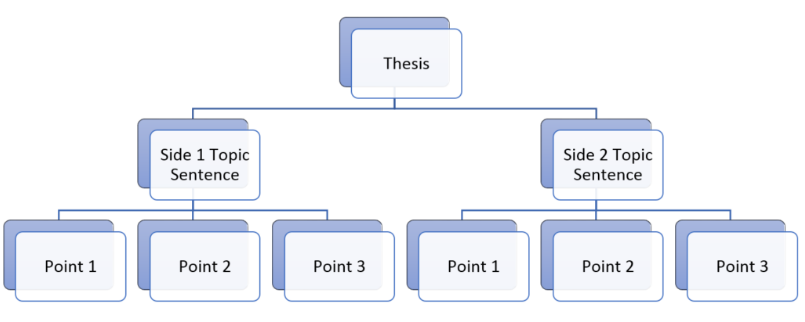
Side by Side
In side by side comparison and contrast structure, you offer all of the information for one thing first before moving to the second.
However, within each side, structure the points of comparison/contrast in the same order. With side by side structure, you may end up with only two topic sentences, or you may end up with general topic sentences to introduce each side, and then a series of more specific topic sentences for each point.
Point by Point
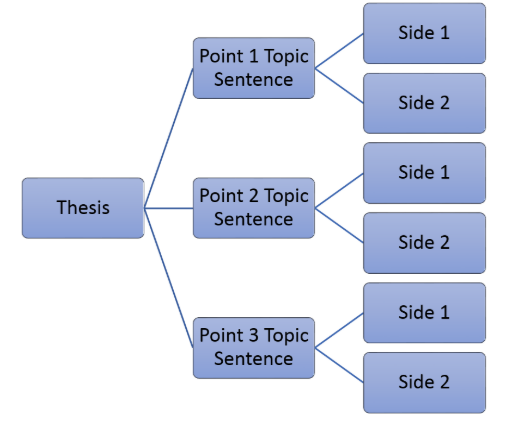
In point by point comparison and contrast structure, you with each point of the comparison/contrast in an order that makes sense given the two things being compared.
However, under each point, the same side always needs to come first.
Division and Classification

When you divide and classify, you break something down into its component parts, offering an insight or analysis into the thing you’re breaking down. You actually use division and classification thinking a lot, perhaps without realizing it (e.g., different personality types of the people you know, different types of cars, different types of activities for your children).
Remember that when using this pattern of organization, you still have to create a thesis sentence that offers an analytical insight (e.g., Of all the sixteen personality types that Myers-Briggs identify, the ___ type is the best to hire in a ___ type of job, for a number of reasons.)
Your then have topic sentences that make a point about each group or class, and you have supporting details for each topic sentenced point. The topic sentences themselves should have angles that relate back to the main angle in the thesis.
Cause and Effect
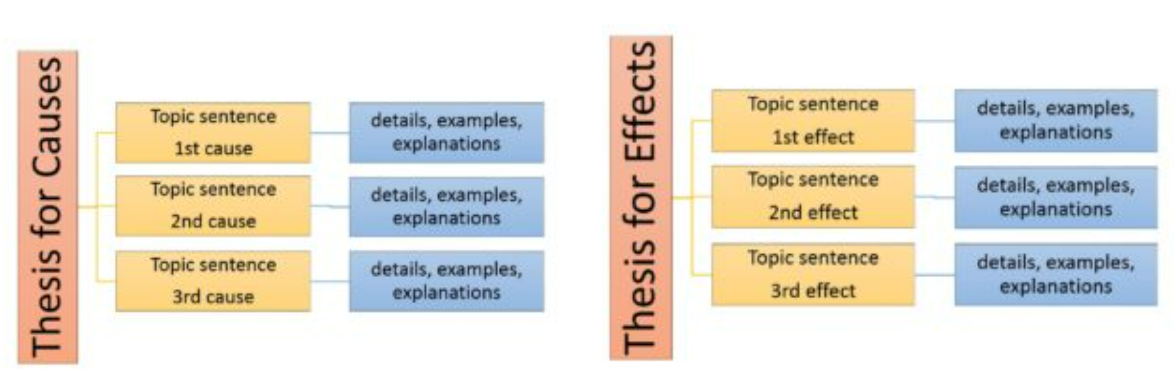
Cause and effect is just what it says. Writing about causes and effects deals with identifying “reasons why” and/or “results.”
The important thing to remember is that this pattern calls for logical inference in dealing with causes, and logical probabilities in explaining effects.
Don’t fall into a logical fallacy (a logical error) by assuming simple and/or incorrect causes or effects. Instead, make sure that you link causes and effects carefully, considering both evidence and probability.
As usual, your thesis, topic sentences, and units of support should show some complexity and offer insights into causes and/or effects, insights which you developed based on your reading.
View the following video for a good summary of patterns of organization. Toward the end, the video includes five sample paragraphs so that you can self-test your ability to recognize different patterns of organization as a reader. Considering patterns of organization as a reader will also give you insight into how to apply them as a writer.
video Organizational Patterns – Text Structure. Authored by: M Ehlers. Located at: https://www.youtube.com/watch?v=8XZK8-SJ-XQ. License: Other. License Terms: YouTube video
Final Thoughts on Structuring Support/Patterns of Organization
- Sometimes understanding a pattern can help you circle back and develop support. For example, if you’re comparing two items in a side by side comparison, you may realize that you do not have parallel information for each side and need to circle back to developing additional support.
- It’s important to remember, though, that you should not force-fit your thoughts and your support into a pattern. Patterns should be organic to your thesis and purpose for writing.
- A clear organizational structure helps your reader follow and understand your thoughts, whether or not the reader is conscious of the structure you used. You experienced that yourself as a reader when you read articles in which ideas were presented clearly and logically.
- Finally and most importantly, keep in mind that you need to review your topic sentences and units of support and make conscious choices about their order. You should be able to articulate your rationale for structuring your support in a certain way.
Exercises
Review the short article “How Crisco Toppled Lard.”
- What overall pattern of organization does the author use for the whole article?
- What pattern/s of organization does the author use specifically in the section on King Crisco?
[reveal-answer q=”1″] Compare your answers [/reveal-answer]
[hidden-answer a=”1″]
- The overall pattern of organization for the whole article is sequential, like a process pattern. The author takes a historical, chronological approach.
- The section on King Crisco uses comparison and contrast, showing similarities and differences between Crisco and other products. Certain words cue you, as a reader, to expect a comparison and contrast pattern: “differently,” “like, ” “in contrast,” and “unlike.” The section on King Crisco also uses cause and effect, presenting reasons why Crisco hid its ingredients.
[/hidden-answer]
Media Attributions
- vardan-papikyan-GFxyhSxsnek-unsplash © Vardan Papikyan is licensed under a CC0 (Creative Commons Zero) license
- alexas_fotos-pros-and-cons-2028471 © Alexas_Fotos is licensed under a CC0 (Creative Commons Zero) license
- vitaly-gariev-hvlURMm_DHc-unsplash © Vitaly Gariev is licensed under a CC0 (Creative Commons Zero) license
- vitaly-gariev-6oyoy4vptUg-unsplash © Vitaly Gariev is licensed under a CC0 (Creative Commons Zero) license
- thedigitalartist-project-management-2738521 © TheDigitalArtist is licensed under a CC0 (Creative Commons Zero) license
- sk-sherazi-uirSXagGvl8-unsplash © SK Sherazi is licensed under a CC0 (Creative Commons Zero) license
- Screenshot 2026-05-14 120651 is licensed under a CC0 (Creative Commons Zero) license
- Screenshot 2026-05-14 120828 is licensed under a CC0 (Creative Commons Zero) license
- shunya-koide-1emWndlDHs0-unsplash © Shunya Koide is licensed under a CC0 (Creative Commons Zero) license
- Screenshot 2026-05-14 132100 is licensed under a CC0 (Creative Commons Zero) license